- La tech est politique
- Posts
- 👓Tech Sovereignty and a Digital Future Made in Deutschland
👓Tech Sovereignty and a Digital Future Made in Deutschland

Rayna Stamboliyska
May 26, 2025 • Temps de lecture : 6 minutes

Bonjour ☕
This edition of La tech est politique explores Europe in motion:
The complete rewriting of the Parliament’s own-initiative report on technological sovereignty; and
The creation of Germany's Ministry for Digital Affairs.
I've decided to discuss these developments with you for two reasons. In Strasbourg, four political groups are transforming a minimalist text into an ambitious roadmap whilst also demonstrating the dynamics of (re)balancing within the current Parliament.
In Berlin, the centralisation of digital competencies aims to overcome federal bureaucratic burdens and demonstrates affinities with a position previously championed largely by France: technological sovereignty.
These initiatives reveal the same urgency: building an open technological autonomy that combines reducing dependencies with international cooperation. The challenge extends beyond regulation; it's about making digital technology a public good, democratically controlled, whilst stimulating innovation.
Why discuss this? We Europeans are testing an unprecedented model here, neither isolationist nor naively liberal, which could redefine the EU's geopolitical role. German success in federal coordination and the European cross-party consensus will serve as good indicators for the future balance between sovereignty and globalisation.
Reading time: 10 minutes (1,655 words)

Hot Potato, Beware: Parliament’s Position on Technological Sovereignty
The Issue. European technological sovereignty has become a burning topic. At the end of 2024, the European Parliament's ITRE committee entrusted Sarah Knafo, an MEP openly hostile to the EU, with drafting a report on this strategic theme. Her draft, delivered in February 2025, was so inadequate that four parliamentary groups prepared a 'counter-report' which replaces it entirely.
What's Changing. Ms Knafo's initial text was superficial and Franco-centric. The parliamentary compromise (EPP, S&D, Greens/EFA, Renew) transforms this draft into a structured document that reflects a profound evolution in the vision of European digital strategy.
A new vision of technological sovereignty. Knafo defined technological sovereignty as 'the capacity to master the strategic technologies necessary for our independence'. The compromise broadens this vision: 'building capabilities and resilience by reducing strategic dependencies whilst preserving European openness'.
The message is clear: Europe doesn't want to isolate itself but to develop an 'open strategic autonomy' - reducing critical dependencies without closing its markets.
Digital public infrastructure. The compromise introduces Digital Public Infrastructure, a ‘base layer’ comprising semiconductors, connectivity, cloud, software, and AI. This infrastructure would guarantee sovereignty while preserving competition.
Unlike Ms Knafo's model (generic, liberal and minimally interventionist), this approach prioritises open standards and interoperability, with dedicated funding.
A comprehensive technological scope. Ms Knafo mentioned AI, cloud, cybersecurity, semiconductors and 5G. The compromise covers all links in the digital infrastructure chain:
Connectivity (fibre, 5G/6G, satellites, submarine cables)
Computing (supercomputers, AI, data centres)
Quantum technologies and post-quantum cryptography
Concrete legislative acts. Where Ms Knafo proposed vague recommendations, the compromise proposes or supports new frameworks:
Digital Public Infrastructure Act (new request);
Digital Networks Act (in preparation, expected by the end of 2025);
Cloud and AI Development Act (in preparation, expected early 2026);
Quantum Act (in preparation, expected shortly).
These proposals are accompanied by a detailed financial framework, with dedicated allocations in the next European budget and coordination with existing funds (Horizon Europe, Digital Europe, etc.).
Beyond regulation. The initial report focused on deregulation with the Trump-style principle 'One-In, Two-Out' (remove two rules for each new rule). The compromise moderates this approach and develops a comprehensive vision:
Training, attracting and retaining talent;
Research and innovation with facilitated pathways to commercialisation;
Energy sustainability (carbon neutrality for data centres by 2030);
Standardisation and international promotion of European standards;
International partnerships through trade agreements.
Why This Development Matters. These initiative reports (INI) allow Parliament to shape legislative priorities. They ask the Commission to submit concrete proposals and have historically influenced numerous European regulations.
The Political Stakes. This rewriting reveals two dynamics. First, the four pro-European groups maintain a 'cordon sanitaire' against Eurosceptics by completely taking over Knafo's work. Second, they display consensus on digital matters, from GDPR to semiconductors and cybersecurity.
The compromise transforms a partial and Franco-centric vision into an exhaustive document on a solid legal foundation. It coherently structures the infrastructure-usage continuum.
Between The Lines. This rewriting reflects broad parliamentary consensus around 'open' technological sovereignty: European autonomy doesn't oppose international cooperation but aims to strengthen the European position through targeted investments.
Europe is moving from simply defending against foreign tech giants to the positive ambition of building a digital ecosystem aligned with its values, with a solid industrial base and democratically controlled infrastructure.
This four-group compromise is unprecedented. Technological sovereignty is becoming a central organising principle of European politics, supported by broad political consensus.
Now What? Vote in the ITRE committee on 3rd June (464 amendments tabled to the Knafo report), then in plenary in early July. Given the consensus of the four groups, the 'counter-report' should be adopted, entirely replacing the initial text.
Not yet a premium 💎 subscriber? Fret not; click the button below and join other entrepreneurs and decision-makers who stay ahead in the ever-changing EU legal landscape thanks to La tech est politique.
On the Horizon: The New German Government's Digital Strategy
What This Is About. The creation of the Federal Ministry for Digital Affairs and State Modernisation (BMDS) in May 2025 represents a significant institutional reconfiguration of German digital governance. The appointment of Karsten Wildberger as Digital Minister consolidates competencies previously spread across six ministries, addressing persistent coordination challenges in public policy implementation.
Why This Development Matters. This consolidation responds to coordination failures that have characterised German digital policy and damaged Germany’s competitive positioning. The CDU/CSU-SPD coalition agreement (Koalitionvertrag) governing the new German government recognises digital policy as a core competency requiring dedicated institutional capabilities.
Institutional Architecture and Ministerial Mandate. The BMDS consolidates several critical functions: digital transformation strategy, data policy coordination, AI implementation, broadband infrastructure promotion, cybersecurity oversight, and development of interoperable platforms. The Ministry also controls approval of federal IT procurement, centralising a historically dispersed and inefficient process.
The mandate encompasses digital identity infrastructure, citizen accounts, complete digitisation of services, and enhanced coordination with the Länder on critical infrastructure. This scope reflects that effective digital transformation requires integrated approaches covering technical infrastructure, regulatory frameworks and delivery mechanisms.
Leadership Profile and Implementation Approach. Karsten Wildberger's appointment prioritises operational expertise over traditional political credentials. His background—physicist, former director at E.ON (50 million customers), Vodafone, T-Mobile and ex-CEO of Ceconomy (1,000+ MediaMarkt/Saturn stores across Europe)—brings significant experience of large-scale digital transformation.
This private sector experience offers both advantages and potential constraints. Wildberger understands managing complex digital operations and commercial efficiency. But public sector transformation operates under different constraints: regulatory requirements, political accountability, federal-Land coordination and public service obligations distinct from commercial environments. More pragmatically, tensions between proclaimed sovereignty and the German industry’s strategic partnerships with AWS/Microsoft will quickly surface and complicate efforts.
Strategic Priorities and Policy Framework. Here are some key elements:
AI development. The coalition positions AI as central to technological strategy, with unspecified budget allocations that could constrain ambitions. The planned expert commission on 'Competition and AI' reflects tension between AI development and competition policy, particularly risks of market concentration.
Digital sovereignty. Digital sovereignty initiatives aim to reduce dependence on non-European suppliers via the 'German Stack' (DeutschlandStack) project. This involves developing dedicated software and cloud environments for public use to build technological autonomy in critical functions. This is complemented by a commitment to open source alternatives and open standards.
Cybersecurity and critical infrastructure protection. The coalition’s cybersecurity strategy integrates the implementation of the NIS2 Directive and Cyber Resilience Act with strengthening institutional capabilities through BSI expansion (Germany’s national cybersecurity agency). Designating BSI as the central coordination authority between federal and Länder levels addresses persistent coordination challenges in German cybersecurity governance.
Establishing the National Security Council, the Chancellery crisis centre, and expanding the national crisis staff indicate that cybersecurity requires intergovernmental coordination rather than sectoral approaches. New BSI guidelines restricting critical infrastructure components to ‘trustworthy countries’ represent a significant policy shift towards security-based technological procurement criteria.
It Won't Be Plain Sailing. The main challenge lies in transforming institutional culture and operational practices across German federal structures. Developing technical infrastructure represents only one component of a comprehensive digital transformation that requires sustained coordination, adequate resource allocation and political continuity across electoral cycles. This transformation's difficulties, trials, and errors will enable other European countries to approach digital technology as a sector of activity that can benefit from dedicated institutional foundations.
What Counts is What Gets Counted
↓
2 | The Commission has already proposed creating a ‘28th regime’ twice: in 2004 and again in 2011. However, this proposal was unsuccessful due to a lack of political will from Member States (notably Germany in 2011). The mechanism has experienced renewed interest thanks to the 2024 Letta and Draghi reports; the Commission has included the project in its work programme. A proposal on the matter is expected for the third quarter of this year. While the subject now regularly makes headlines, its contours remain unclear. Whatever the proposal, Member States and Parliament will need to be convinced; if the timetable is maintained, the Danish Presidency of the EU will lead coordination on the member state side. We shall see how Parliament's balance of power is (re)composed. |
Travel is Life
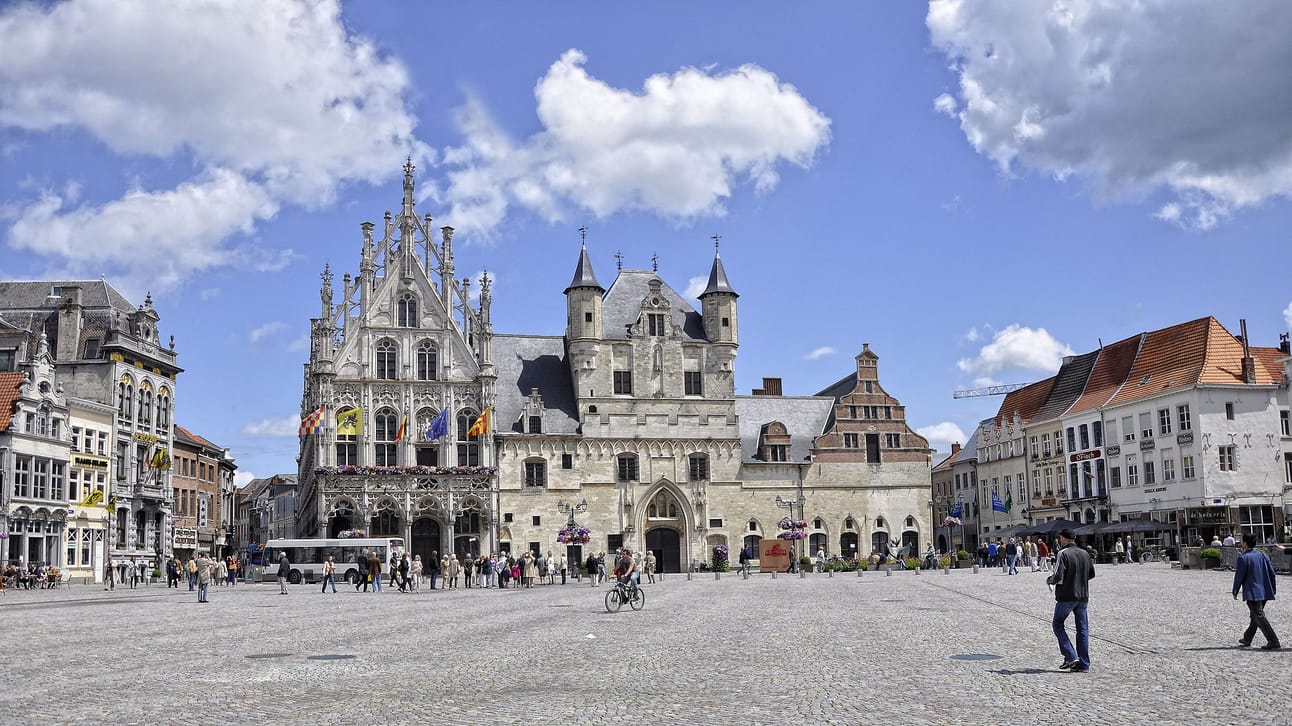
Mechelen/Malines town hall. Photo by Paul Hermans on Wikimedia Commons, CC-by-SA 3.0
At the end of April, I was invited to keynote at the Cyber Resilience Conference in Mechelen/Malines, in Dutch-speaking Belgium. It was the first time I'd visited the region. As I arrived the day before, and the weather was lovely, I ventured to explore the city.
I learnt, for example, that in many Flemish towns, the inhabitants of a municipality have mock nicknames. The one bestowed upon the people of Mechelen is Maneblussers, or 'Moon Extinguishers'. The story goes that one night in January 1687, a gentleman was leaving a tavern after a festive evening. He began rallying nearby residents, calling them to fetch water because St Rumbold’s Cathedral was ablaze. But when people started rushing over with buckets full of water, they realised it was an illusion: the orange reflections were those of… the Moon. The nickname stuck.
Oh, and if you fancy a snack, try the aged Gouda, which is served with… mustard.
This is a complimentary free edition of the Premium newsletter.
Not yet a premium 💎 subscriber? Fret not; click the button below and join other entrepreneurs and decision-makers who stay ahead in the ever-changing EU legal landscape thanks to La tech est politique.